
Where we buy
Marcellus Shale (Appalachia)
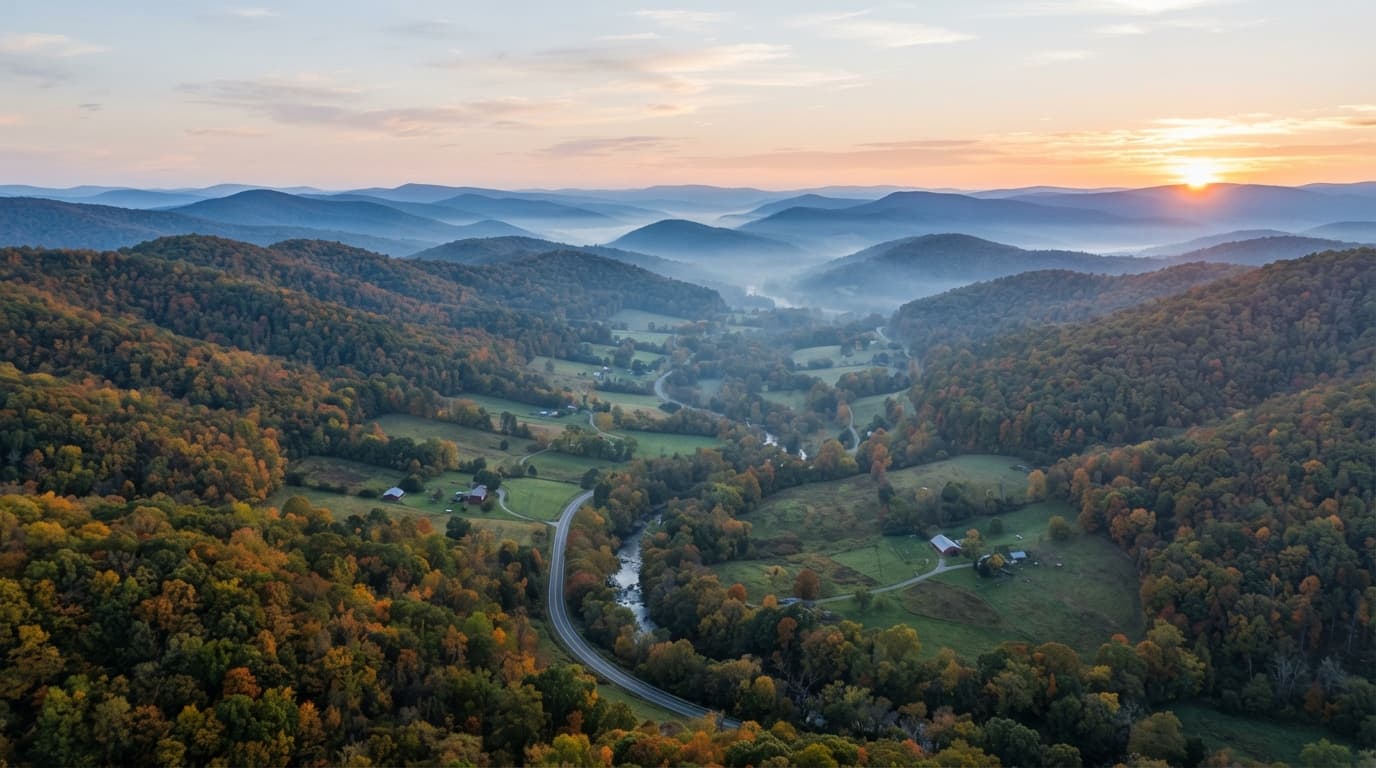
The Marcellus made the United States the world’s largest natural-gas producer. It spans the Appalachian hills of Pennsylvania and West Virginia, and underneath much of it sits a second target — the deep Utica — which means a single tract can carry two plays’ worth of value.
The rock, in plain English
How the Marcellus really works.
The Marcellus is a Middle Devonian black shale that sorts itself into windows that pay very differently. Southwest Pennsylvania (Washington, Greene) and much of northern West Virginia are wet — gas plus natural-gas liquids like ethane and propane — while northeast Pennsylvania (Susquehanna, Bradford) is dry but extraordinarily high-rate. Which window your acres sit in shapes your check more than almost anything else.
Beneath a large share of the Marcellus lies the deep Utica / Point Pleasant — the same interval Ohio produces, but thousands of feet deeper here. In parts of West Virginia and Pennsylvania it has delivered some of the highest-pressure gas wells in the country. For an owner that means stacked potential: one tract, two zones, value that an offer pricing only the Marcellus can quietly leave out.
Development came fast after 2008 and then matured into a manufacturing play — held-by-production acreage, ever-longer laterals, and infill wells rather than land rushes. The constraint here has rarely been the rock; it’s been takeaway. Pipeline capacity out of Appalachia, and the basis discount that comes with it, is a central input to what a Marcellus royalty is actually worth.
What moves the money
What a fair offer in the Marcellus accounts for.
These are the lines we’ll walk you through before any number goes on paper.
Your window — wet or dry
Wet-gas acreage in southwest PA and northern WV is paid on gas plus liquids; dry-gas acreage in northeast PA is paid on volume. They price on different math, and the county and township on your deed set which one applies.
Appalachian basis
Local gas has long sold below the national benchmark because pipelines out of the basin fill up. That differential — and where it’s headed as new takeaway comes on — belongs in any honest valuation, not buried in a low number.
Deep Utica optionality
Under much of the Marcellus sits an undrilled deep Utica bench. Real, but timing-dependent — we price producing Marcellus wells and weigh the Utica upside as a separate, conservative line.
Metes-and-bounds title
Pennsylvania and West Virginia have no township-and-range survey; tracts are described by old metes-and-bounds and warrant names, and heirship runs deep. Reading that chain carefully is the work — and West Virginia’s co-tenancy rules add their own wrinkle.
On the map
Counties we see most.
Where the Marcellus files usually come from — though we read every county in the basin.
- Washington (PA)
- Greene (PA)
- Susquehanna (PA)
- Bradford (PA)
- Marshall (WV)
- Wetzel (WV)
- Doddridge (WV)
- Tyler (WV)
By state
Selling rules differ by state line.
Pooling, title quirks, and taxes follow the state — our state guides cover them.
- Selling mineral rights in Pennsylvania
- Selling mineral rights in West Virginia
- Selling mineral rights in Ohio
Want a number to anchor on first? The value estimator has the Marcellus’s rule-of-thumb ranges built in, and the hold vs. sell comparator uses its decline assumptions. No email required for either.
No pressure, ever
Whenever you’re ready — even if that’s never.
Tell us a county and a name — we’ll do the the Marcellus homework at our cost and walk you through what you own, whether or not you ever sell.
No automated calls. No mailers with sight drafts. No follow-up unless you ask for it.
Rather talk to a person? (970) 444-7374or email hello@eldoradomp.com